What is extended producer responsibility, and where did it come from?
Extended producer responsibility (EPR) is the most widely adopted policy instrument for financing the management of post-consumer packaging in the industrialised world, and among the most contested. This article traces the concept from its Swedish origin in 1990, through its parallel construction in Germany, to the succession of official definitions that have progressively narrowed it — and explains why the vocabulary disputes that surround the term are, in substance, disputes about who pays and who decides.
1. An unusually well-documented origin
Few policy concepts have as precise a birth record as extended producer responsibility. The term has a named inventor, a dated report, and an exact founding definition — and, equally well documented, a substantial gap between what that inventor proposed and what governments subsequently built. The history is not of merely antiquarian interest. Most present-day disagreements about EPR — whether it is a financing mechanism or a design-change instrument, whether "product stewardship" is the same thing, whether producers or consumers really pay — are re-runs of choices made between 1990 and 2001, and a reader who knows which definition a given speaker is using can usually predict that speaker's position on the substantive questions.
The concept originated at Lund University in Sweden. In 1990, Thomas Lindhqvist, a researcher at what became the university's International Institute for Industrial Environmental Economics (IIIEE), together with Karl Lidgren, prepared a report for the Swedish Ministry of the Environment titled Modeller för förlängt producentansvar — "Models for Extended Producer Responsibility." It was published as a chapter in the Ministry volume Från vaggan till graven ("From the Cradle to the Grave," Ds 1991:9). The Swedish term is instructive: förlängt producentansvar means producer responsibility that is prolonged — stretched further along the product's life cycle — which captures the original idea more faithfully than the English word "extended" does.
The canonical definition arrived two years later, in Lindhqvist's 1992 contribution to a further Ministry volume (Varor som faror, Ds 1992:82). It merits quotation in full, because nearly every element has since been negotiated away somewhere:
"Extended Producer Responsibility is an environmental protection strategy to reach an environmental objective of a decreased total environmental impact from a product, by making the manufacturer of the product responsible for the entire life-cycle of the product and especially for the take-back, recycling and final disposal of the product."
Four commitments are embedded in that sentence. EPR is a strategy, not a funding mechanism. Its objective is decreased total environmental impact, not a recycling rate. Its scope is the entire life cycle, not the post-consumer stage alone. And its subject is the manufacturer — not a collective body, and not a "steward." The subsequent history of EPR can be told, without much exaggeration, as the story of each of those four commitments being softened in implementation.
Lindhqvist's doctoral thesis, completed at Lund in 2000 (Extended Producer Responsibility in Cleaner Production), formalised the framework and introduced its most durable analytical device: the distinction between five types of producer responsibility — liability, economic, physical, informative, and ownership. Any actual scheme can be described as a selection from these five, and the selection determines nearly everything downstream. The scaffold has proved quietly predictive: informative responsibility is the intellectual ancestor of the European Union's Digital Product Passport, and ownership responsibility anticipated product-as-service business models. As Section 4 shows, the EU's 2018 legal definition is in effect a legislated collapse of the five types into one or two.
2. Parallel invention: Germany builds the machine
While Lund supplied the concept and the name, Germany built the first operating system — and the two developments occurred essentially in parallel, with no documented cross-influence before 1991.
West Germany's 1986 Waste Act had relied on voluntary measures and was widely judged a failure. A landfill-capacity crisis — roughly 32 million tonnes of annual waste against an estimated two to five years of remaining disposal capacity — pushed the federal environment minister, Klaus Töpfer, toward mandatory measures. Töpfer's decisive move was structural rather than fiscal: he conditioned the coming packaging ordinance on industry organising its own compliance system. The result was Duales System Deutschland (DSD), founded by retail and consumer-goods companies in September 1990 to license the Green Dot mark — the world's first packaging producer responsibility organisation, created before the law that would make it necessary. The Verpackungsverordnung (Packaging Ordinance) followed in 1991, with take-back obligations phasing in through 1993 and mandatory material-specific quotas.
The sequencing matters for how the field understands itself. Lindhqvist's 1990 report predates the ordinance's adoption, but the German drafting process (1989–90) was contemporaneous and, so far as the documentary record shows, independent: no source documents either side citing the other before 1991. The safest characterisation, and the one this library uses, is parallel invention — Sweden supplied the concept and the name; Germany supplied the first operating system. Lindhqvist's own thesis treats Germany as the first large-scale implementation of a principle he had already articulated.
Two features of the German original became hereditary traits of packaging EPR worldwide: the producer-organised collective compliance body (the producer responsibility organisation, or PRO), and the fee-financed collection system operating in parallel to municipal waste services. A third German legacy — the competition-law difficulties that a sanctioned producer monopoly generates — took a decade longer to surface, culminating in the antitrust-driven break-up of DSD's monopoly, the subject of the only rigorous natural experiment on PRO competition in the literature.
3. The pre-history: what EPR absorbed
EPR did not emerge from nothing; it named and systematised arrangements that already existed.
Deposit-refund systems on refillable beverage containers are producer-run recovery systems roughly a century old. The Container Recycling Institute, a US research organisation focused on beverage container recovery, has reasonably described them as "perhaps the earliest form of EPR system." The legislated versions — British Columbia's beverage deposit in 1970 and Oregon's "Bottle Bill" of 1971 — predate the EPR concept by two decades.
Advance disposal fees were the market-based alternative debated in the United States through the 1980s: a per-unit charge levied at sale to fund end-of-life management. Florida briefly enacted one (a 1988 act, with the fee effective in 1992, later repealed). The instrument survives today inside EPR vocabulary as the "eco-fee" — and, as discussed in the comparison article, it is analytically a different instrument from EPR despite superficial resemblance.
The covenant route was pioneered by the Netherlands, whose 1991 Packaging Covenant was a negotiated agreement between government and industry rather than a regulation. It remains the standard contrast case to German-style command-and-control.
The French adaptation came within a year of the German ordinance. Décret 92-377 of April 1992 licensed Eco-Emballages (the ancestor of today's Citeo) and established the éco-organisme template: a state-approved, fee-collecting, target-carrying producer organisation. This, rather than the German original, is the institutional form most of the world now uses.
4. The definitions, and their progressive narrowing
The field operates on at least four load-bearing definitions, and they are not the same. The differences are not pedantic; each definition commits its users to a different answer on what EPR is for.
| Source | Core wording | What it commits to |
|---|---|---|
| Lindhqvist (1992) | "environmental protection strategy… decreased total environmental impact… entire life-cycle… take-back, recycling and final disposal" | Whole life cycle; manufacturer-centric; impact reduction as the objective |
| OECD (2001, retained 2016) | "an environmental policy approach in which a producer's responsibility for a product is extended to the post-consumer stage of a product's life cycle," with responsibility shifted "physically and/or economically; fully or partially" upstream, plus design incentives | Post-consumer stage only; physical and/or economic responsibility; explicitly compatible with partial coverage; design incentives as a defining feature |
| EU Waste Framework Directive, Art. 3(21) (2018) | "a set of measures taken by Member States to ensure that producers of products bear financial responsibility or financial and organisational responsibility for the management of the waste stage" | Financial (or financial plus organisational) responsibility only; physical responsibility and design language dropped from the definition itself |
| US state statutes (2021–25) | Various: Maine's "Stewardship Program for Packaging"; Colorado's producer-funded statewide program; Oregon's explicit shared-responsibility model; California statutorily equating "product stewardship, sometimes known as EPR" | A spectrum from full-cost to partial coverage; "stewardship" and "EPR" used interchangeably in statute |
The drift across these four rows is directional, and it is the single most important fact in EPR's conceptual history: each successive codification narrows Lindhqvist's whole-life-cycle design strategy toward end-of-life financing. The Organisation for Economic Co-operation and Development (OECD), whose 2001 Guidance Manual for Governments remains the international reference document, retained design incentives within the definition but confined the scope to the post-consumer stage. The EU's 2018 amendment to the Waste Framework Directive dropped design from the definition entirely, recovering it only partially through a separate provision (Article 8a(4)(b)) permitting fee modulation. Several US statutes are, by the Canadian test described below, not producer-responsibility programs so much as producer-payment programs.
The narrowing matters because the instrument is still marketed on the promise of the 1992 definition while operating on the terms of the 2018 one. When advocates describe EPR as a tool that will make packaging fundamentally more sustainable, they are quoting the founder; when practitioners describe what their systems actually do, they are describing the directive. Both call their object "EPR," and much of the disagreement reviewed in the following article stems from that unacknowledged difference.
5. The terminology politics: "stewardship" versus "responsibility"
The vocabulary has always been part of the fight, and the North American record documents this unusually well.
In the United States, the softening began at the federal level in the 1990s. The President's Council on Sustainable Development, in its 1996 report Sustainable America: A New Consensus, adopted the phrase "extended product responsibility" — the same acronym, with the word producer deleted. Contemporaneous work commissioned by the US Environmental Protection Agency attributes the substitution explicitly to an American preference for a term implying "shared responsibilities in the product chain" rather than obligations concentrated on manufacturers. The phrase "shared responsibility" has functioned ever since as the diluting frame: it is the vocabulary in which producer obligations become partial, negotiated, or contingent. The Product Stewardship Institute, a US policy organisation founded in 2001, chose the softer name while promoting genuinely producer-funded legislation — the naming itself an artifact of the terminology battle rather than a substantive position.
Canada produced the sharpest formal distinction, and it remains the most analytically useful test in the literature. The Canadian Council of Ministers of the Environment (CCME), the intergovernmental body of federal, provincial and territorial environment ministers, defined the terms precisely in its Canada-wide Action Plan for Extended Producer Responsibility (approved October 2009). EPR programs are those "in which manufacturers and importers are fully and directly responsible for both the funding and operation of programs"; product stewardship programs are those "in which manufacturers and importers are neither directly responsible for program funding nor for program operations." The action plan then supplies the sentence that makes the distinction operational:
"To a consumer an EPR and a product stewardship program can look similar but it is the lack of ability of producers to directly influence program funding, cost, design and operations that distinguishes the two approaches."
This is a control test, not a labelling convention: if the producers who fund a system cannot influence its cost, design and operations, it is stewardship, whatever the statute calls it. On this test, a program's label is checkable against its architecture — and a number of programs titled "EPR" fail it, while some titled "stewardship" pass. British Columbia's own regulatory history traces the migration: product-specific "stewardship" regulations beginning with paint in 1994 (the first EPR-regulated product in North America) were consolidated into an explicit EPR framework under the province's 2004 Recycling Regulation.
The practical guidance for any reader is simple: when a program is described as "product stewardship," ask who pays and who controls; when a statute says "EPR," check it against the CCME test. The terms are used interchangeably in the United States — California's statute does so explicitly — and precisely in Canada, a standing source of cross-border confusion.
6. Diffusion: a fifty-year timeline
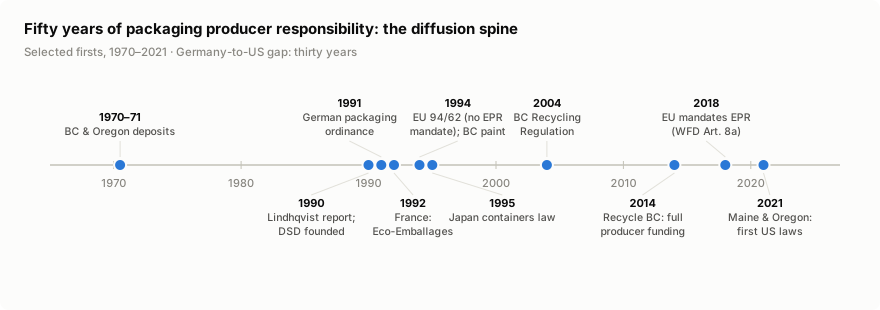
The instrument's spread can be dated with unusual precision. The packaging-relevant sequence:
- 1970–71 — British Columbia and Oregon enact beverage container deposits: proto-EPR, two decades before the concept.
- 1990 — Lindhqvist and Lidgren's report for the Swedish Ministry; DSD founded in Germany (September).
- 1991 — The German Verpackungsverordnung: the first national packaging EPR ordinance. Minnesota and New Jersey enact rechargeable-battery take-back laws, the first US producer take-back mandates.
- 1992 — France's Décret 92-377 licenses Eco-Emballages, establishing the éco-organisme template.
- 1993–94 — Austria (ARA) and Belgium (Fost Plus) follow; Sweden adopts producer-responsibility ordinances; British Columbia regulates paint, the first North American EPR product; the EU's Packaging and Packaging Waste Directive (94/62/EC) harmonises targets but does not mandate EPR — member states chose their own instruments, which is why the United Kingdom adopted a tradable-certificate system (packaging recovery notes) whose structure persists today.
- 1995 — Japan's Containers and Packaging Recycling Law.
- 2003–04 — South Korea formalises its EPR system; Maine enacts the first US e-waste EPR law; British Columbia's Recycling Regulation consolidates its EPR framework.
- 2011–14 — British Columbia adds packaging and printed paper; Recycle BC becomes the first residential packaging program in North America funded approximately 100% by producers.
- 2018 — The EU amends the Waste Framework Directive (Directive 2018/851): packaging EPR becomes mandatory across the Union (schemes required by 31 December 2024), with minimum requirements — including cost-coverage floors and fee-modulation provisions — set out in Article 8a.
- 2021–25 — The US state wave: Maine (July 2021, the first state packaging EPR law), Oregon (August 2021), Colorado and California (2022), Minnesota (2024), Washington and Maryland (2025).
Two features of this timeline reward attention. The first is the thirty-year gap between Germany (1991) and the United States (2021) — itself an analytical datum, the subject of a substantial political-science literature on American resistance to producer obligations, and the backdrop to the striking reversal in which parts of the packaged-goods industry came to support the very instrument they had long opposed. The second is the pattern of adoption: by the OECD's count there were roughly 400 EPR schemes worldwide by 2016, about three-quarters adopted after 2001 — meaning the instrument's global diffusion largely postdates, and rests on, the OECD's codification rather than on the Swedish original.
7. What the history settles, and what it leaves open
Three propositions from this history carry weight in current debates.
First, EPR's founding definition promised impact reduction through whole-life-cycle producer responsibility, and no operating packaging scheme implements that definition. The honest description of what exists is collectively financed post-consumer waste management with design aspirations. Whether that gap represents failure or sensible adaptation is the subject of the next article; that the gap exists is not seriously disputed.
Second, the terminology distinctions are substantive. The CCME control test — who funds, who operates, who decides — sorts real programs more accurately than statutory labels do, and "shared responsibility" language reliably signals partial producer obligations.
Third, the parallel-invention origin explains a permanent tension in the field. The academic literature evaluates EPR against Lindhqvist's design promise; practitioners operate descendants of Töpfer's financing machine. Both call their object "EPR," and a large share of the field's recurring arguments — reviewed throughout this library — are, at bottom, arguments between those two inheritances.
Finally, the historical record has known gaps, which this library flags rather than papers over: no primary source documents the Swedish Ministry's motive for commissioning the 1990 report; no documentary evidence establishes cross-influence between Bonn and Lund during 1989–91; and several conventional dates in the diffusion timeline rest on the general literature rather than on verified primary documents.
References
- Lindhqvist, T. & Lidgren, K. (1990). Modeller för förlängt producentansvar, in Swedish Ministry of the Environment, Från vaggan till graven — sex studier av varors miljöpåverkan (Ds 1991:9).
- Lindhqvist, T. (1992). "Mot ett förlängt producentansvar — analys av erfarenheter samt förslag," in Varor som faror — Underlagsrapporter (Ds 1992:82). Source of the founding definition quoted in Section 1.
- Lindhqvist, T. (2000). Extended Producer Responsibility in Cleaner Production. IIIEE Dissertation 2000:2, Lund University.
- OECD (2001). Extended Producer Responsibility: A Guidance Manual for Governments; OECD (2016), Extended Producer Responsibility: Updated Guidance for Efficient Waste Management. Definitions retained verbatim across both editions.
- Directive (EU) 2018/851 amending Directive 2008/98/EC on waste, Art. 3(21) and Art. 8a.
- Canadian Council of Ministers of the Environment (2009). Canada-wide Action Plan for Extended Producer Responsibility, p. 4. Quoted directly in Section 5.
- President's Council on Sustainable Development (1996). Sustainable America: A New Consensus.
- Maine LD 1541 (2021); Oregon SB 582 (2021); Colorado HB22-1355 (2022); California SB 54 (2022) and CalRecycle statutory language.
- European Parliament and Council Directive 94/62/EC on packaging and packaging waste.
- Container Recycling Institute, EPR primer — deposit systems as proto-EPR.
- Historical accounts of the German origin: ZSVR (the German packaging registry authority) historical materials; INFORM, Germany, Garbage and the Green Dot.
- Nash, J. & Bosso, C. (2013). Extended Producer Responsibility in the United States: Full Speed Ahead? Harvard Kennedy School working paper — the standard scholarly account of US EPR/stewardship politics.
- Retrospective interviews with Thomas Lindhqvist (Packaging Europe; Resource/Ecoveritas, 2023), discussed further in the two-goal article.
Verification note: bibliographic details in this article were checked against publisher and official records during this library's citation audit (see Sources and method). Known gaps in the historical record are stated in Section 7 rather than filled by conjecture.