What is eco-modulation, and how does it work in practice?¶
Eco-modulation — the variation of producer fees according to design attributes such as recyclability, recycled content or the presence of recycling disruptors — exists to repair extended producer responsibility's foundational defect: collective schemes pool end-of-life costs and allocate them by market share, severing the link between a firm's design choices and the fee it pays (the structural analysis). Modulation is the patch — re-differentiate the fee so that better design costs less. This article explains what modulation actually is: its four operational forms, which are routinely conflated; the attributes it prices; its history from the French bonus/malus system to the EU legal mandate; how the major schemes implement it as of 2026; and the recurring practical problems — gaming, administrative burden, perverse interactions and capture — that any implementation must manage. Whether it changes design is the next article's question; this one establishes what "it" is.
1. Four forms under one name¶
"Eco-modulation" describes at least four operationally distinct mechanisms, and analysis goes wrong when they are conflated.
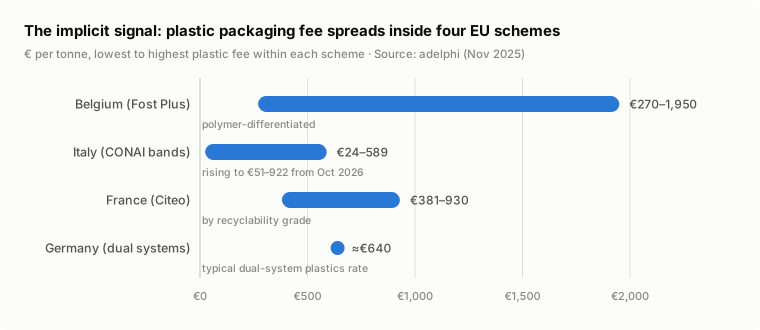
Implicit (cost-based) differentiation. Fees reflect the actual net cost of managing each material: flexible films cost multiples of clear PET because they cost more to collect and sort and earn less when sold. Nearly every scheme does this, and the resulting spreads are enormous — the Netherlands charges €17 per tonne for paper against €1,320 for flexible plastics within a single tariff. This is modulation only in a loose sense: the differential tracks system cost rather than a policy choice, though the incentive effect on producers is similar.
Explicit bonus/malus. A deliberate surcharge or discount tied to a design attribute, layered on top of the cost-based fee — France's malus of up to 25% on complex multilayers; Quebec's surcharge on PVC and degradable plastics.
Banded or graded fees. Materials placed into discrete recyclability bands carrying different rates — Italy's CONAI bands (spanning roughly €51–922 per tonne from October 2026), the UK's red/amber/green ratings, and prospectively the EU's harmonised A–C grades.
Attribute-triggered rebates. Bonuses claimed per product on submitted evidence — Oregon's life-cycle-assessment-based bonuses; Citeo's recycled-content bonus; the French textile scheme's per-item durability bonuses.
One structural observation belongs at the outset because it frames everything downstream: the implicit cost-based spreads dwarf the explicit bonus/malus layers in every operating scheme. Belgium's cost-anchored spread between its cheapest and dearest plastics exceeds €1,600 per tonne; no explicit bonus in Europe approaches that. This raises a question the field rarely confronts — whether "eco-modulation" as a named instrument adds any signal beyond what honest full-cost internalisation already provides.
2. What gets modulated¶
The modulation basis varies by regime, and the list has been expanding: recyclability (nearly universal); recycled content (France, the Netherlands' recyclate discount, the EU regulation prospectively); reusability (Oregon, France); sortability and detectability (the carbon-black rules — dark pigments invisible to near-infrared sorting equipment); disruptor presence (the French perturbateur lists — attributes that contaminate recycling streams); durability and repairability (textiles under the revised EU framework); and toxics (California's statutory surcharge for heavy metals and harmful additives). Each basis carries its own verification burden, a point that returns in Section 6.
3. History: from the Green Dot to the EU mandate¶
France is the documented birthplace and the field's reference chronology. Eco-Emballages (founded 1992, operator of the Green Dot mark) differentiated fees by material, weight and unit count from the start — implicit modulation. True bonus/malus began on 1 January 2012, on legal footing from the 2010 Grenelle 2 law: an 8% bonus for prevention actions and sorting instructions, and a 100% malus on packaging classed as non-recyclable or as a recycling disruptor.
The pivotal governance episode came in 2017. A ministerial order of 7 July 2017 mandated the 2018–2022 modulation schedule for all three approved French producer organisations: a 100% malus on plastic bottles not made of PET, HDPE or PP; a 50% malus on disruptors; a 12% PET-bottle bonus. Two features of the episode matter beyond France. First, the most controversial element — the malus on opaque PET — was forced by government decree after NGO and citizen mobilisation, not volunteered by the schemes; the French state's own audit bodies have repeatedly documented why (producer-governed schemes prioritise contribution levels over target attainment — the governance record). Second, the state harmonised the schedule across competing schemes — an early acknowledgment that modulation cannot function as a competitive variable, a lesson Germany would learn negatively (Section 4).
The EU mandate arrived with Directive (EU) 2018/851, inserting Article 8a(4)(b) into the Waste Framework Directive: collective-scheme contributions must be "modulated, where possible, for individual products or groups of similar products, notably by taking into account their durability, reparability, re-usability and recyclability and the presence of hazardous substances... and where available, based on harmonised criteria." The Commission commissioned guidance (from the consultancy Eunomia, published 2020) but never formally adopted it, and the "harmonised criteria" provision was never used — producing fifteen-plus national modulation systems with incompatible bases, the fragmentation that the Packaging and Packaging Waste Regulation's hard-law grades now exist to fix (the comparison article).
France then escalated once more: the 2020 anti-waste law (AGEC) and the 2021 climate law shifted the system from percentage adjustments toward penalties that "may exceed the base fee" and bonuses that can zero it out — the strongest statutory modulation authority anywhere.
4. Practice by jurisdiction, 2026¶
France (Citeo) runs the fullest apparatus: maluses to 25% on complex multilayers; a recycled-content bonus reaching 15% for bottles with at least 80% recycled PET; a 10% transparent-PET bonus; sector coefficients scaling the whole tariff by market segment; and the field's most sophisticated single mechanism — a recycled-content bonus of €0.40/kg for PET derived from trays against €0.05/kg for bottle-derived PET, an eight-fold differential deliberately constructed to conjure a tray-to-tray recycling market into existence. France's textile scheme (Refashion) shows what modulation looks like beyond packaging and at its most granular: per-item durability bonuses of €0.07–1.05, certification bonuses of €0.03–0.30 across eight accepted labels, a recycled-material bonus of €1,000 per tonne of post-consumer content conditioned on sourcing within 1,500 km, mandatory disruptor penalties since 2025 — and a rule that a penalised product can receive no bonus, closing the offsetting problem that Section 6 documents in the packaging schedule.
Germany is the cautionary case: a statutory duty nullified by market structure. Section 21 of the Packaging Act requires the dual systems to incentivise recyclable design against an annually published minimum standard — but competition among roughly ten systems for producer clients has prevented meaningful differentiation, since no system can unilaterally penalise the packaging of customers it is trying to retain. German policy discussion has consequently turned to a statutory fund model operating outside the competitive fee system. The general lesson: a legal mandate for modulation is not self-executing; market structure can nullify it.
The Netherlands (Verpact) is the deliberate ratchet case: recyclability assessments distinguishing rigid from flexible formats, layered with a recycled-content discount doubled to €0.20/kg in 2025 — a rare documented instance of a scheme raising a differential specifically because it judged the prior signal too weak. Revealed preference, from inside the system, about dose.
Italy (CONAI) operates cost-anchored recyclability bands with a documented differential approaching 4:1, rising to a €51–922/t span from October 2026 — with the increase rationale explicitly cost recovery rather than design ambition.
The United Kingdom modulates from its second year through the red/amber/green Recyclability Assessment Methodology: red-rated packaging pays 1.2 times the amber fee, green earns roughly 9% below it, with the 2027 methodology tightening (automatic red for PFAS above 1 ppm, non-compliant inks, integrated electronics). Some 89% of producers still hold amber- or red-rated packaging — the modulation's addressable population is most of the market.
Quebec (ÉEQ) operates Canada's only true malus and is escalating it into the internationally significant case: from a 20% surcharge on PVC, PLA and other degradable plastics (2024) to announced 2027 penalties of 75% on PVC and 50% on PLA, alongside an ecodesign bonus crediting up to half a producer's contribution. The Quebec maluses are distinctive because they target whole polymers for effective exclusion — approaching de facto material bans enacted through a fee schedule, with the legal-exposure questions that implies.
Oregon is the most interesting US design: bonuses only, no maluses, and uniquely grounded in life-cycle assessment. Producers may earn fee reductions through three tiers — disclosure (up to 10% of base fees), demonstrated life-cycle impact reduction (20–30% depending on magnitude), and reuse/refill conversion (capped per product) — all requiring ISO-conformant assessments with independent critical review. The rigour is the point, and also the cost: the compliance expense of claiming a bonus can exceed the bonus for smaller producers. Colorado's proposed schedule is unusual among US programs in including maluses; California wrote the broadest statutory basis (recyclability, toxics, source-reduction credits) and then simplified modulation to broad material categories for the first two program years under cost pressure — ambition deferred.
5. The governance pattern¶
Across this record one regularity stands out strongly enough to state as a proposition: the strength of modulation in a jurisdiction tracks the strength of the state's hand over the scheme, not the scheme's environmental commitment. France's meaningful maluses were imposed by ministerial decree over scheme resistance; Germany's statutory duty dissolved in a competitive market no ministry disciplines; Quebec's escalation is the choice of a designated monopoly body under active government modernisation; the UK's modulation is set by the state administrator directly. The finding connects to Theme 2's governance evidence — bodies controlled by fee-payers do not voluntarily sharpen the instruments that raise their members' fees (the conflicts article).
6. The practical problems every implementation must manage¶
Gaming and misclassification. Under any banded system, the boundary between bands is worth money, and the party declaring the classification is the party paying the fee. The first US consolidated reporting round documented data-quality problems serious enough to require a formal reclassification policy; no adjudicated fraud case over modulation claims yet exists, but the incentive structure is plain (the verification article).
Administrative burden as a scale advantage. France requires declarations at the individual consumer-unit level; Oregon requires ISO-grade life-cycle assessment with independent review. For small producers the cost of claiming a bonus can exceed the bonus — quietly converting an environmental incentive into an advantage for large firms.
Perverse interactions. In the 2018 French schedule, a 10% recycled-cardboard bonus could be exactly offset by a 10% mineral-oil-ink malus — netting the signal to zero on precisely the products where two attributes were in play. Attribute-by-attribute fees also cannot see deeper trade-offs: lightweighting that increases food waste; recyclability purchased at the cost of durability.
Fee-fairness capture. Modulation disputes reliably become material-sector proxy wars. The UK's current fight is the exhibit: the glass sector argues it pays over a quarter of system costs on under 8% of tonnage and demands volume-based fees; the fibre sector warns that modulation "incentivises more plastic." Every material association favours the modulation design that favours its material, and a regulator adjudicating between them is doing distributional politics under a technical name.
7. Where the argument stands¶
Eco-modulation is best understood not as a single instrument but as a family of re-differentiation mechanisms, ranging from the cost-based spreads every scheme already runs to deliberately punitive polymer surcharges approaching bans. Its history is a governance story as much as a design story: the mandate spread from French decree to EU directive to every new North American statute in under a decade, while the harmonisation that would make signals coherent for multinational producers never arrived — and, on the documented record, ambition has come from states, not schemes. The machinery is now universal; its doses remain small relative to the cost-based differentials beneath them; and its practical pathologies — gaming margins, compliance-cost regressivity, offsetting interactions, sectoral capture — are documented features, not hypotheticals. What all of this machinery has actually done to packaging design is the evidence question, taken up next.
References¶
- Lakhan, C. (2026). Ecomodulation of Extended Producer Responsibility Fees: A Literature Review. Working paper, Circular Innovation Hub, York University — the consolidating review whose framework this theme follows.
- Directive (EU) 2018/851, Art. 8a(4)(b) — the EU mandate, quoted in Section 3; the Eunomia guidance (2020) commissioned and never formally adopted.
- Arrêté of 7 July 2017 (Journal Officiel) — the mandated French 2018–2022 schedule; the April 2017 opaque-PET decree; loi AGEC (2020) and the climate law (2021) — the strengthened French authority.
- Laubinger, F. & Brown, A., with Börkey, P. & Dubois, M. (2021). Modulated Fees for Extended Producer Responsibility Schemes. OECD Environment Working Paper No. 184 — the definitive policy treatment; source of the CONAI differential and comparative mechanism data.
- Scheme documentation: Citeo modulation guides and tray-to-tray bonus materials; Verpact 2025 tariff revision (the doubled recyclate discount); Fost Plus and CONAI tariffs; ÉEQ 2024 malus and announced 2027 structure; Oregon ORS 459A.944 and DEQ bonus program documentation; Colorado HB22-1355 and the CAA proposal; California PRC §42053 and the revised CalRecycle regulations (May 2025); Defra/PackUK Producer Fees Modulation Policy Statement (2025) and RAM 2027 overview.
- On Germany's §21 VerpackG and its nullification by market structure: German policy analyses and the statutory-fund discussion, as synthesised in Lakhan (2026).
- IGF/IGEDD/CGE (2024) and Cour des comptes (2020) — the governance findings underlying Section 5.
Verification note: mechanism details are drawn from primary scheme documentation where available and from the OECD's comparative treatment elsewhere; the corrected attribution history of this library's modulation sources is preserved in Sources and method.